Watercourse BNG Units for Sale
Our Watercourse BNG units provide an off-site solution where additional watercourse habitat value is required.
Purchasing the appropriate units helps address your biodiversity net gain requirement, supporting the Biodiversity Gain Plan and helping your development progress through the planning process.
Price from
£104,947.50
per biodiversity unit
Planning compliant
30 years
legally secured BNG delivery.
Purchase increments
0.01 units
flexible purchasing to meet your 10% BNG requirement.
Fast Turnaround
48 hours
Allocation Agreement issued within 48 hours of payment.
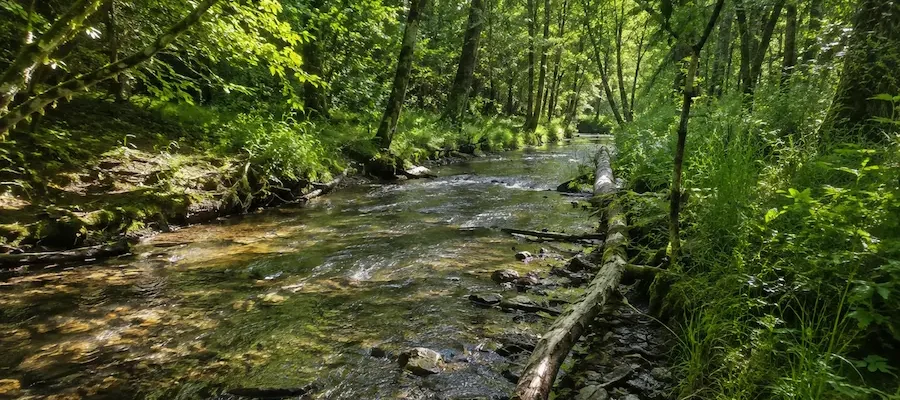
CURRENT AVAILABILITY AND PRICING
Watercourse Units Available for Development Projects
Watercourse BNG units are available from £104,947.50 per watercourse unit.
These units are calculated separately from area habitat and hedgerow units within the Biodiversity Metric. They can still be purchased in increments of 0.01, but the correct quantity must first be confirmed through the watercourse module.
We will review the watercourse classification, development location and unit requirement before confirming the available allocation and full quotation.
Your BNG unit requirement can be priced within a 5 minuite conversation with one of highly trained Client Managers.
UNDERSTANDING THE REQUIREMENT
Why Does My BNG Assessment Require Watercourse Units?
Watercourse units may be required where a river, stream, canal or ditch is affected by a development, or where the project needs to deliver a measurable improvement within the watercourse section of the Biodiversity Metric.
A watercourse is more than the water flowing through it. Its biodiversity value also comes from the channel, banks, nearby vegetation and the connections it creates across the surrounding landscape.
When these features are in good condition, they can support aquatic plants, fish, invertebrates, birds and mammals. They also provide natural movement corridors, helping wildlife travel between habitats and strengthening the wider ecological network.
Watercourse units are calculated separately from area-habitat and hedgerow units. This means a watercourse shortfall must be addressed within the watercourse module and cannot be replaced with surplus grassland, woodland or hedgerow units.
1
Existing habitat is assessed
The metric records the habitat affected by the proposed development.
2
A shortfall is calculated
On-site measures are accounted for before any off-site requirement is confirmed.
3
Suitable units are allocated
The habitat, location and unit requirement are reviewed before purchase.
HABITAT ASSESSMENT
How Watercourse Units are Assessed
Watercourse units are assessed separately from area habitats and hedgerows because rivers, streams, canals and ditches function as connected systems rather than isolated parcels of land.
The assessment looks beyond the water itself. It considers the physical condition of the channel, the banks, surrounding vegetation and the way the watercourse connects with the wider landscape.
An ecologist may consider:
• whether the channel follows a natural or heavily modified course;
• the condition and structure of the banks;
• the presence of native marginal and riparian vegetation;
• variation in flow, depth and channel features;
• barriers that restrict the movement of wildlife;
• artificial reinforcement, culverts or hard engineering;
• shading from surrounding vegetation;
• signs of erosion, pollution or physical disturbance;
• how well the watercourse connects with ponds, wetlands, woodland and other habitats.
These features help show whether the watercourse provides varied habitat or has become simplified through straightening, deepening, artificial banks or intensive management.
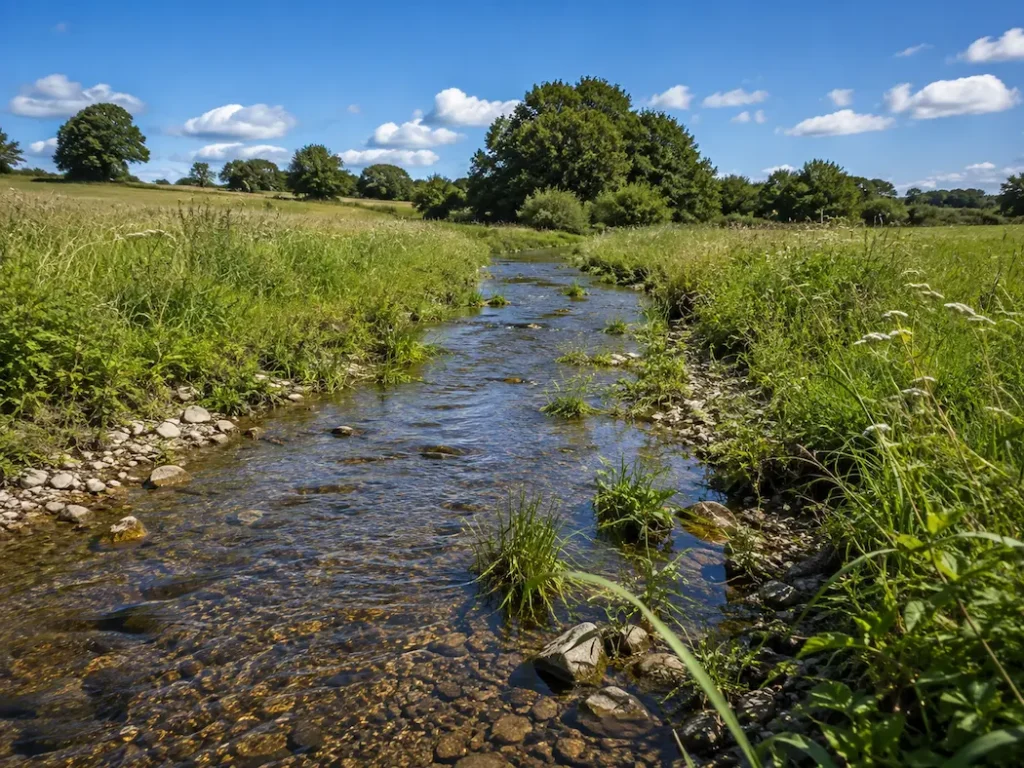
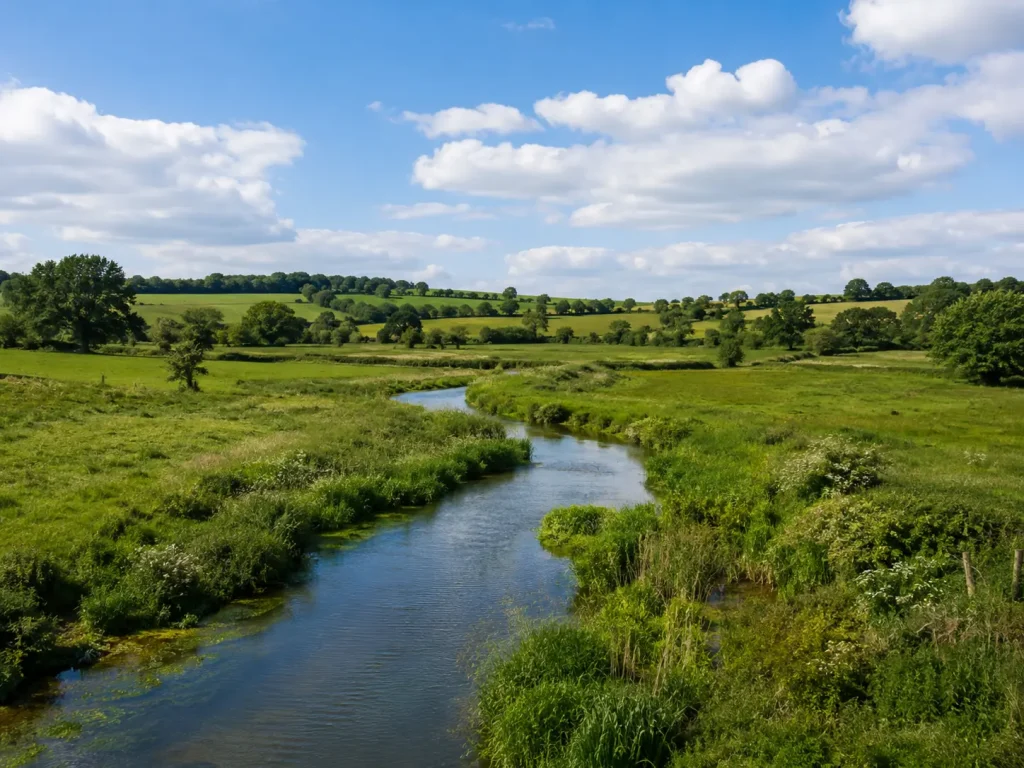
Two stretches of watercourse can therefore have very different biodiversity values, even when they are similar in length. A naturally structured channel with vegetated banks, varied margins and good ecological connections can support far more wildlife than a uniform, heavily modified section.
The Biodiversity Metric uses the watercourse type, length and condition to calculate its value. For habitat creation or enhancement, it also considers the time required to reach the target condition and the risk involved in delivering the proposed improvement.
The location of the off-site gain may also affect how many units can be counted towards a development. Watercourse units must be matched to the shortfall shown within the watercourse section of the metric and cannot be replaced with surplus grassland, woodland or hedgerow units.
Habitat type
What is present or being created
Condition
The ecological quality achieved
Area
The extent of the habitat parcel
Location
How spatial rules affect allocation
CREATION AND MANAGEMENT
How Watercourse Habitat is Created and Managed
Creating or enhancing watercourse habitat involves restoring the channel, banks and surrounding vegetation as one connected ecological feature. It is not simply a matter of clearing vegetation or improving the appearance of the water’s edge.
The work begins with an assessment of how the watercourse currently functions. This may include its flow, channel shape, bank condition, surrounding land use, vegetation and connections to nearby habitats. Existing pressures, such as artificial structures, erosion, excessive shading or poor marginal vegetation, also need to be understood before the right management approach can be selected.
Depending on the watercourse and its agreed target, enhancement may include:
• restoring more natural channel features;
• creating variation in flow and water depth;
• softening or regrading damaged banks;
• establishing native marginal and bankside vegetation;
• reducing bare or eroding sections;
• controlling invasive plants;
• managing excessive shading while retaining valuable tree cover;
• creating buffers between the watercourse and intensive land use;
• improving habitat connections along the channel.
The aim is to create a more varied environment. Different depths, flow conditions, bank profiles and vegetation types provide opportunities for aquatic plants, invertebrates, fish, birds and mammals.
Management must also respond to the natural movement of water. Flooding, erosion, sediment movement and seasonal changes are part of a functioning watercourse, so the objective is not to hold every feature in a fixed position. Instead, management supports natural processes while protecting the habitat from avoidable damage.
Ecological monitoring records changes in the channel, banks, vegetation and overall condition. Where the watercourse is not progressing towards its agreed target, the management plan can be adjusted through further planting, erosion control, invasive-species management or changes to shading and surrounding land use.
This long-term programme supports the biodiversity value attached to each unit. The investment covers the restoration, protection and monitoring of a functioning watercourse corridor, rather than a one-off piece of landscaping or drainage work.
Establish
Prepare and develop the required plant community.
Manage
Apply planned cutting, grazing and vegetation control.
Monitor
Record condition and progress against habitat objectives.
Adapt
Adjust management where monitoring identifies a need.
LONG-TERM DELIVERY
Long-Term Habitat Delivery
Each unit is backed by habitat on land owned and managed by BNG Solutions UK. We remain responsible for the conservation covenant, ecological oversight, ongoing management and monitoring required to deliver the habitat for at least 30 years.
These responsibilities, and the associated long-term costs, remain with us.
THE PURCHASE PROCESS
From Metric Review to Completed Allocation
Send your metric
Provide the development location and unit requirement.
Suitability review
Habitat type, spatial rules and availability are checked.
Confirm allocation
Pricing, documentation and allocation details are agreed.
Complete and register
The units are allocated to the development and DEFRA registered.
What We Need to Confirm Your Allocation
To carry out an initial review, we will usually need your completed Biodiversity Metric, development postcode and the number of Watercourse units identified. Where available, you can also send your Biodiversity Gain Plan and any relevant planning correspondence.
Watercourse BNG Units FAQs
Watercourse BNG units are off-site linear biodiversity units generated by creating or enhancing rivers, streams or other eligible watercourse habitats on a biodiversity gain site. They can be allocated to a development where the Statutory Biodiversity Metric identifies a compatible watercourse-unit shortfall that cannot be met entirely on-site.
Watercourse units are calculated separately from area habitat and hedgerow units.
Yes. High-distinctiveness watercourse BNG units are currently available through BNG Solutions UK, subject to the number of units required, the development location and compatibility with the completed Biodiversity Metric.
We review suitability and current availability before any purchase or allocation is agreed.
High distinctiveness is a habitat classification used within the Statutory Biodiversity Metric. It reflects the ecological characteristics and relative distinctiveness of the watercourse habitat rather than simply its physical size.
Condition is assessed separately. Where a development loses high-distinctiveness watercourse habitat, the metric’s trading rules require replacement with watercourse units of the same habitat type.
Send us your completed Biodiversity Metric and development location. We will review:
- The watercourse habitat type
- Its distinctiveness and condition
- The number of units required
- The applicable trading rules
- The relationship between the development and gain site
Depending on the watercourse type, the metric assessment may also include a River Condition Assessment, riparian-zone encroachment and watercourse encroachment.
No. Watercourse units can only be used within the watercourse module of the Statutory Biodiversity Metric. They cannot be converted into area habitat units or hedgerow units.
Compatibility also depends on the watercourse habitat affected. High-distinctiveness watercourse losses must be replaced with units generated by the same habitat type.
Yes. A development can affect watercourse units without permanently removing the river or stream.
Works within the channel, banks or surrounding riparian zone may reduce watercourse condition or increase encroachment. Buildings, hardstanding, structures, intensive land management or restricted access to the riverbank can all affect how the watercourse is recorded in the metric.
No. One watercourse biodiversity unit does not correspond to a fixed number of metres.
Watercourses are measured by their centre-line length in kilometres, but the number of units generated also depends on factors such as:
- Watercourse habitat type
- Distinctiveness
- Condition
- Strategic significance
- Riparian-zone encroachment
- Watercourse encroachment
This means two watercourse sections of the same length may generate different numbers of units.
High-distinctiveness watercourse BNG units are currently available from £119,940 per biodiversity unit.
The final cost depends on the number of units required.
Yes. Watercourse BNG units can be purchased in increments of 0.01 units, allowing the allocation to be matched closely to the shortfall shown in the Biodiversity Metric.
Yes. The location of the off-site watercourse provision must be considered in relation to the development and the relevant river system.
Compensation for watercourse losses should be delivered on a section with similar natural habitat features. The spatial relationship between the development and the gain site may therefore affect suitability and the final number of units required.
The purchase provides the agreed number of watercourse BNG units for allocation to your development.
BNG Solutions UK also supports:
- The allocation agreement
- Biodiversity gain site registration requirements
- Recording the allocation against the development
- The information needed to evidence the off-site units within the Biodiversity Gain Plan
Any fixed administration, registration and allocation charges will be shown clearly within the quotation.
BNG Solutions UK remains responsible for the ecological delivery, management and monitoring of the watercourse habitat in accordance with the Habitat Management and Monitoring Plan and legal agreement.
The habitat will be legally secured and managed for a minimum of 30 years. The purchaser does not become responsible for routine watercourse management, ecological monitoring or the associated long-term delivery costs.
START WITH YOUR BIODIVERSITY METRIC
Check whether Watercourse units are right for your development
Send the metric, development location and required number of units. Our team can review suitability and confirm current availability before you commit.